
For upcoming events click here:
https://thenorthernguthub.com/regionalteachings/
Endoscopy training guides and summaries
I have gathered a range of valuable resources and concise summary guides from the NETA training academy designed to assist you in enhancing your endoscopy skills! Stay tuned for more updates and additional materials to follow soon.

Paris classification
Polypoid > 2.5 mm high (about the height of closed biopsy forceps)
Ip (pedunculated) – on a stalk
Is (sessile) – broad base
Non-polypoid ≤ 2.5 mm
IIa slightly elevated – rises, but never over 2.5 mm
IIb flat – flush with mucosa (no measurable bump)
IIc slightly depressed – shallow dip without an ulcer
Mixes exist (e.g. 0-IIa+IIc).
III excavated – true ulcer crater (rare)
Relevance
Submucosal-invasion risk climbs sharply:
0-IIa 0.7 – 2.4 %
0-IIc 27 – 36 %; > 40 % if just 6–10 mm, > 90 % if > 20 mm (asge.org)
Management
First-line removal
Ip /-Is
Standard snare
IIa ≤15 mm
Cap or underwater EMR
Any IIc or IIa+IIc
Plan en-bloc ESD or refer for surgery
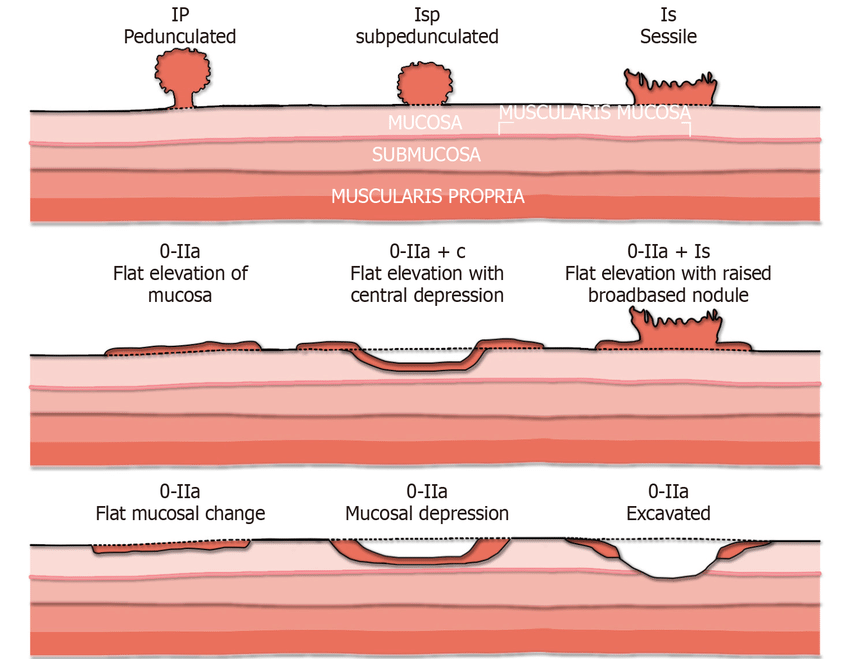
References below image 1
KUDO pit pattern
Kudo’s pit-pattern system helps you decide, in real time, whether a colorectal lesion is benign or malignant. Magnify the surface with dye spray or NBI, look at the crypt openings (“pits”), and match what you see to one of six patterns.
Type I round pits – healthy mucosa; non-neoplastic
Type II stellar / papillary pits – hyperplastic or inflammatory; non-neoplastic
Type IIIS small tubular pits (< 0.05 mm) & IIIL large tubular pits (> 0.05 mm) – adenoma; low invasion risk
Type IV branching / gyrus-like pits – villous adenoma or high-grade dysplasia
Type VI irregular pits – distorted crypts; superficial submucosal invasion likely
Type VN non-structured surface – pits lost; deep submucosal invasion almost certain
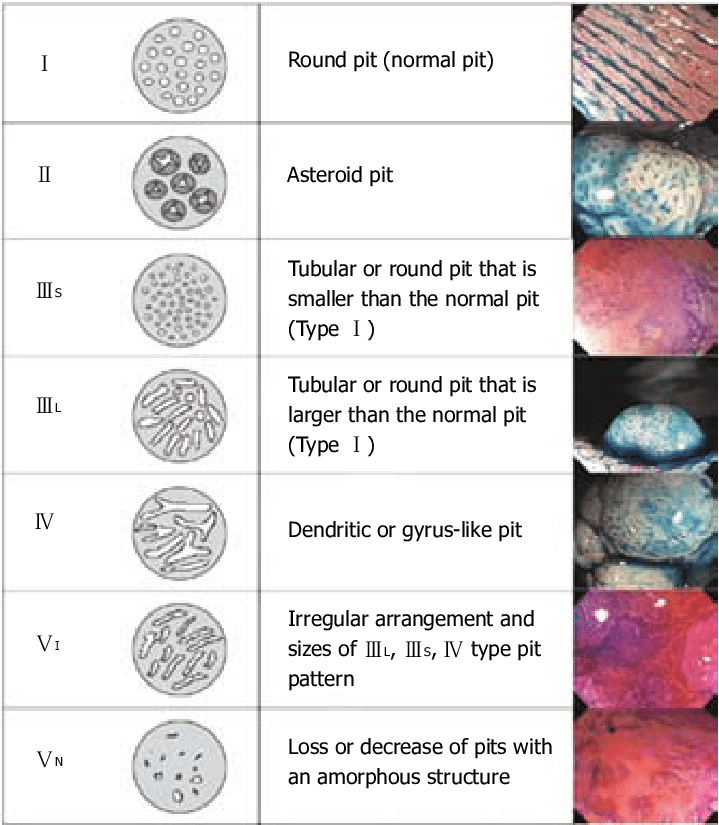
References below image 2
What is EmPath?
EmPath (EMpowering endoscopy trainees in PATHology recognition and management) is a series of study days which aim to improve pathology recognition and management in endoscopy. Anecdotally, trainees have consistently reported a lack of confidence around pathology recognition. Access to pathology teaching can be difficult and opportunistic, especially in the context of shortened specialty training.
It is entirely feasible that you can be signed off for endoscopy without ever having seen a significant spread of pathology. The EmPath days were developed by senior trainees in order to address this. The days are delivered by trainees with consultant input in specialist areas in the North East.

Join Us at EmPath
If you’re an endoscopy trainee looking to broaden your exposure to diverse pathologies, enhance your decision-making skills, and boost your confidence in the endoscopy suite, EmPath is here to help. Our interactive study days are designed to complement your hands-on clinical training, ensuring you feel fully prepared to handle a variety of endoscopic findings.
For more information about EmPath study days—including upcoming sessions, registration details, and how to get involved—please contact:
Eleanor Hackney: eleanor.hackney@nhs.net
Fraser Brown: fraser.brown2@nhs.net
For upcoming events click here:
https://thenorthernguthub.com/regionalteachings/
We look forward to helping you gain the knowledge and skills you need to excel in endoscopy and deliver the highest standard of care to your patients.

References
Image 1.Endoscopic management of colorectal polyps: From benign to malignant polyps – Scientific Figure on ResearchGate. Available from: https://www.researchgate.net/figure/The-Paris-endoscopic-classification-of-colorectal-polyps-Adapted-from23_fig1_354635288 [accessed 6 Jul 2025]
Image 2 Clinical significance of type V-I pit pattern subclassification in determining the depth of invasion of colorectal neoplasms – Scientific Figure on ResearchGate. Available from: https://www.researchgate.net/figure/Classification-of-pit-patterns-of-colorectal-lesions_fig1_5663319 [accessed 6 Jul 2025]